

The Perfect Push-Up: How to Do It and How Hard It Really Is
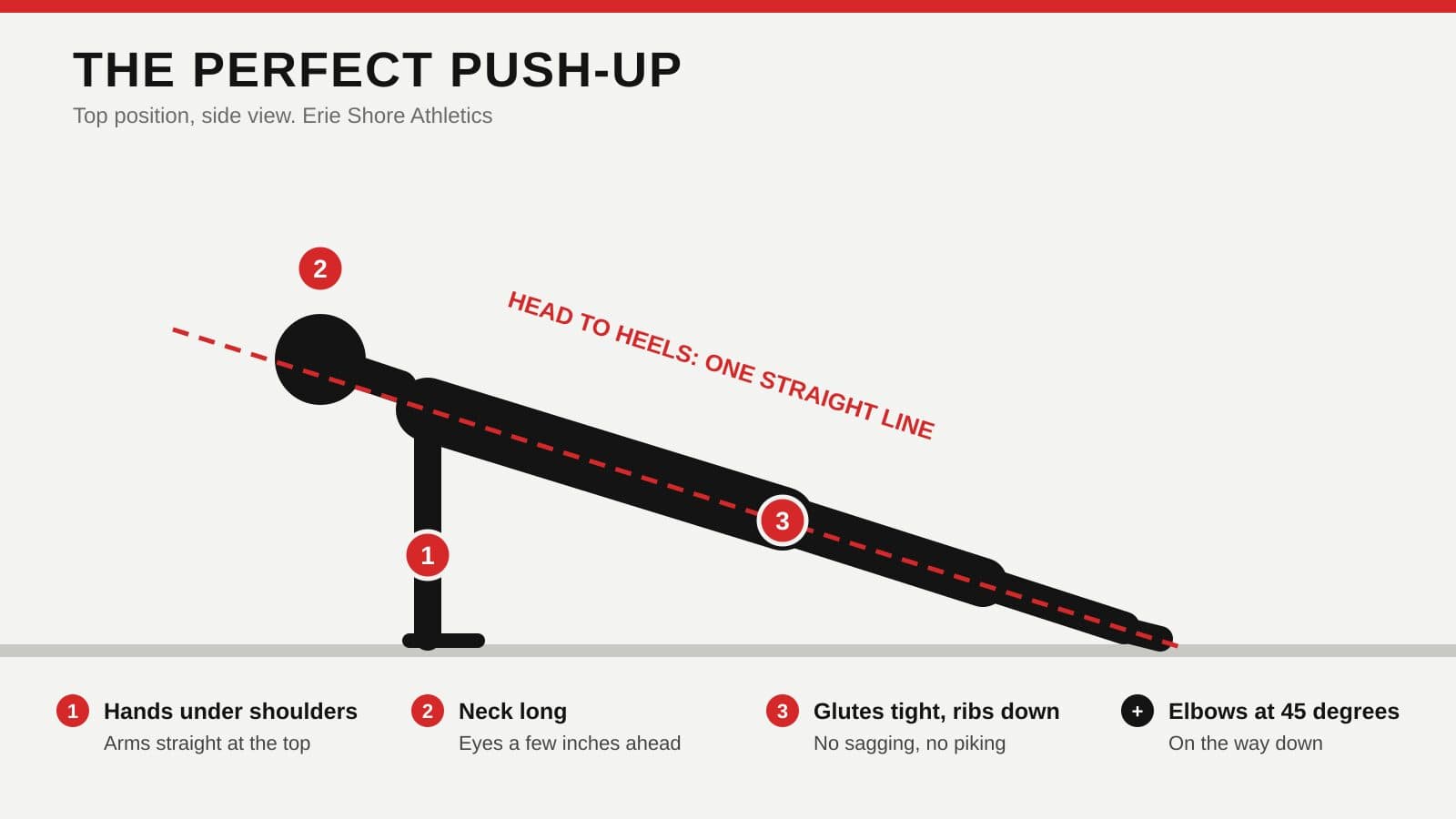
The push-up looks simple. Hands on the floor, push. Then someone tries one with good form and finds out the truth: a real push-up is hard.
I'm Coach Terry. I've coached a lot of athletes through their first clean push-up, and I'll tell you the same thing I tell them. If yours doesn't look like the picture above yet, you're in good company. Let's break it down.
What a Perfect Push-Up Looks Like
Think of your body as one stiff plank. From the top of your head to your heels, everything moves together.
- Hands under your shoulders. Fingers spread, pointing forward. Arms straight at the top.
- Body in one straight line. Squeeze your glutes. Pull your ribs down, like you are bracing for a light punch to the stomach.
- Neck long. Look at the floor a few inches ahead of your hands. Don't crane your chin up or tuck it into your chest.
- Lower as one piece. Elbows point back at about 45 degrees from your ribs. Not flared out like the letter T.
- Chest to the floor, or close. Go as low as you can while keeping the line.
- Press back up the same way. Hips and chest rise together. No snake wiggle.
The two most common mistakes are hips that sag toward the floor and hips that poke up in the air. Both mean the trunk isn't doing its job. Fix that first.
How Hard Is a Push-Up, Really?
Here's the honest answer. In a standard floor push-up, you are pressing roughly two-thirds of your body weight. Studies that measured it landed around 64 percent. Do the math: at 200 pounds, that's about 130 pounds you push off the floor, with your shoulders, chest, triceps, and trunk all working at once.
Now picture doing that for rep after rep with perfect form. That's why people who can bench press a good amount still struggle to bang out ten clean push-ups. The push-up is a strength test and a core test at the same time.
Knee push-ups drop it to about half your body weight. An incline push-up with your hands on a bench is easier still. The higher your hands, the lighter the load. That's what makes the push-up easy to scale, and it's why nobody should feel bad about starting small.
Real talk: if you can do 10 solid push-ups with every rep looking like the picture, you are strong. If you can do 3, you are on your way. If you can do 0 today, you now have a starting line. All three are fine.
How to Build Up to It
You don't need to hit failure to get better. Pick the version where you can control every rep, and earn the next one.
- Wall push-up. Stand an arm and a half from the wall and press. Learn the plank shape with almost no load.
- Incline push-up. Hands on a counter, bench, or box. Lower the surface as you get stronger.
- Knee or low incline push-up. Keep the straight line from knees to head. No sagging.
- Floor push-up. Full plank, chest to floor, one clean press.
Stay on a step until you can do 3 sets of 8 to 10 clean reps. Then move down a level. Two or three days a week after your warm-up is plenty. On your last set, try a slow 3 second lower. It's a quiet way to get strong fast.
If your wrists complain, hold a pair of dumbbells as handles, or make a fist and keep your wrist straight. If your shoulders pinch, bring your elbows in closer to your sides.
Please check with your doctor before starting or changing an exercise routine, especially if you take medication, have a medical condition, or are dealing with an injury. This post is general fitness information and not medical advice.
Want a Coach to Check Your Form?
A push-up looks different from the inside than it does from the outside. Our coaches will watch your reps, find the step that fits you today, and build you a plan to get to that first clean one, or your fiftieth. Book your free intro at Erie Shore Athletics and let's get you moving.
Coach Terry